
Let’s get one thing straight before egos get hurt:
AI is not coming to “support” Product Owners. It’s coming to expose weak ones.
If your value as a PSPO-certified Product Owner is limited to writing user stories, updating backlogs, and running refinement meetings, you’re already standing on thin ice. AI didn’t create this problem — it simply made it visible.
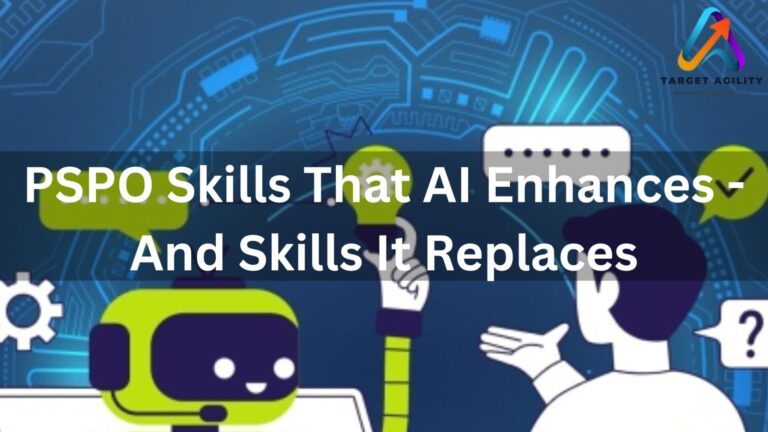
The Product Owner role is evolving fast, and AI is the catalyst. Some PSPO skills are becoming more powerful than ever. Others? They’re quietly becoming irrelevant.
PSPO Skills That AI Enhances (If You’re Smart Enough to Use It)
1. Backlog Refinement and Structuring
AI can analyze massive amounts of user data, support tickets, analytics, and feedback to suggest backlog items in minutes.
A strong Product Owner uses AI to start smarter conversations, not to blindly accept outputs.
If AI helps you refine faster, you gain time for strategic thinking. If you don’t use it, you waste hours debating low-value items.
2. Prioritization with Evidence, Not Opinions
AI excels at identifying patterns — revenue impact, churn risks, feature usage, and dependencies.
This means prioritization is no longer about who shouts the loudest in stakeholder meetings.
Good PSPOs use AI insights to defend decisions with data, not gut feelings.
3. Outcome Prediction and Risk Analysis
AI can forecast delivery risks, adoption probability, and even feature failure based on historical trends.
This gives Product Owners a massive advantage in roadmap discussions.
AI doesn’t replace judgment — it sharpens it.
4. Stakeholder Communication
Summarizing complex product data into executive-level insights is something AI does extremely well.
The best PSPOs use AI to communicate clearer, faster, and with less noise.
PSPO Skills That AI Is Replacing (Whether You Like It or Not)
Now for the uncomfortable part.
1. Writing Basic User Stories
Let’s be honest: writing “As a user, I want…” is not a premium skill anymore.
AI can generate well-structured user stories, acceptance criteria, and even edge cases in seconds.
If this is your core value, you’re replaceable.
2. Manual Backlog Grooming
Dragging tickets around Jira, rewriting descriptions, and doing cosmetic updates is not product ownership.
AI automates this better, faster, and without fatigue.
Product Owners who still spend hours here are misusing their role.
3. Guess-Based Estimation Support
AI doesn’t “estimate” like humans — it analyzes historical delivery patterns.
This makes gut-feel commitments look amateurish.
If your contribution to sprint planning is “this feels like a 5-pointer,” AI has already outgrown you.
4. Reporting Without Insight
Basic reports, burn-up charts, and velocity summaries are automated now.
What matters is interpretation and decision-making, not generating the report itself.
The Real Shift: From Output Manager to Outcome Owner
AI is forcing a brutal but necessary evolution of the PSPO role.
Product Owners who survive and thrive will:
- Focus on product outcomes, not features
- Use AI to validate hypotheses before building
- Challenge stakeholders with data-backed narratives
- Make fewer assumptions and faster decisions
Product Owners who resist AI will keep doing busywork — until leadership notices how unnecessary that busywork is.
Final Truth Product Owners Need to Hear
AI will not replace Product Owners.
But it will replace Product Owners who confuse activity with impact.
PSPO certification alone won’t save you. Jira expertise won’t save you.
What will save you is your ability to:
- Think strategically
- Make hard trade-offs
- Own product results
- Use AI as leverage, not competition
AI didn’t lower the bar for Product Owners.
It raised it – sharply.